◆
Miner
Produces blocks and earns the block reward. In later eras it must also post stake as a bond.
 Tesseracoin™
Universal blockchain platform
Tesseracoin bakes in the properties most blockchains defer: post-quantum-safe signatures, incentivised archival storage, and consensus that matures era by era — from Pure PoW to staking, then PoA or Pure Proof-of-Stake — all without hard forks.
A tessera was a small mosaic tile — and, in ancient Rome, a token handed out at public distributions to ordinary citizens. Many small pieces forming a greater whole; many contributors, one shared community. That is exactly what Tesseracoin is built to be.
Tesseracoin is a universal blockchain platform combining light Proof-of-Work, post-quantum cryptography, and a rewarded librarian role that keeps the network's full history alive — with pluggable consensus eras that mature as a network grows.
Built for the long term — not a someday upgrade.
Most chains defer critical properties — quantum-safe signatures, storage accountability, governed rule upgrades — to a future version that may never ship. Tesseracoin makes them structural from day one.
The big idea
A new network starts simple and safe, then graduates itself to faster, richer consensus as it matures — automatically, no hard fork and no flag day. Here's the whole story in plain terms.
Produces blocks and earns the block reward. In later eras it must also post stake as a bond.
Keeps every block forever and serves old data on demand — the network's archive.
Validates and relays the whole chain independently, but doesn't mine. Maximum self-trust.
Keeps only recent blocks (drops old bodies) to run on modest hardware. Can't serve history.
Not a node — a browser key-holder that signs locally and trusts no single node.
Blocks can only safely speed up as the network sheds the “two miners found a block at once” race — a modest step with stake, then a big leap once there's no race at all.
The fair-launch bootstrap. Anyone with a CPU mines from block 1; that's how the first coins are distributed — so there's nothing to stake yet. A safe cadence, because PoW is the most prone to two miners colliding (orphans ≈ a few %).
Once coins exist, holders lock stake. It's still a mining race, so this is only a modest step to 30s — what stake really adds is slashing security and instant, deterministic tie-resolution (reorgs stay one block shallow).
The real leap: a mature network elects one proposer per slot — no mining race at all — so blocks stay both fast and low-orphan, even with thousands of participants.
The network promotes itself when it has genuinely earned it — measured by things that cost real work and real money, not by how many nodes someone spins up.
Each era carries a deterministic promotion rule every node checks the same way: the next era activates only when all of its conditions are met at once — enough cumulative mining work, enough total locked, slashable stake, and a minimum number of blocks the current era has run (its dwell). Each step sets its own thresholds, and that minimum run-time keeps an era from flipping before it's safe. When the conditions are met, the next era activates on its own at a fixed height.
Counting nodes would be trivial to fake (spin up a hundred). Counting work and staked money can't be — that's the Sybil-resistance. The founding multisig is kept only as an emergency override / rollback, never needed for the normal path.
What's new: a blockchain that graduates its own consensus through multiple eras automatically as it matures — a repeating ladder, not a one-time switch, a hard fork, or a committee vote.
Each block, a fixed ~1 TESC goes to one random active participant — equal odds for everyone taking part with skin in the game, never weighted by how much they hold. It pays for showing up, not hoarding. (No stake-weighting, no APR yield.)
Stake isn't a savings account — it's a slashable bond. Miners must post it to produce; everyone who stakes gains a governance vote, and their stake is part of what trips the next era. Misbehave (double-sign) and it's burned.
Keeping old history is real work, so it earns real reward: librarians that prove they still hold the data (a storage challenge) are paid — funding a durable archive instead of relying on goodwill.
Don't want a growing disk? Run a lightuser — it keeps only recent blocks and drops the rest. Want the network to never forget? Run a librarian — it keeps everything and earns the storage reward, so any pruned node (or a future app) can always recall an old block on demand.
Where this is today vs. next.
Shipping now: all the consensus eras, real locked & slashable stake, block recall + proof-of-storage, and pruning/librarian/light nodes — with era switches today triggered by an on-chain multisig activation. On the roadmap (this design): the automatic, Sybil-resistant era promotion above, the flat participation reward, and the librarian storage payout. We describe the destination so you can see where it's headed.

Random rewards flow to active members — engagement is what pays, not sitting on a balance.
A slashable stake layer carries part of the security load that raw hash power otherwise would.
Post-quantum signatures are built in now — not on a someday roadmap.
Consensus rules change through a governed, on-chain process — software-style releases, not community schisms.
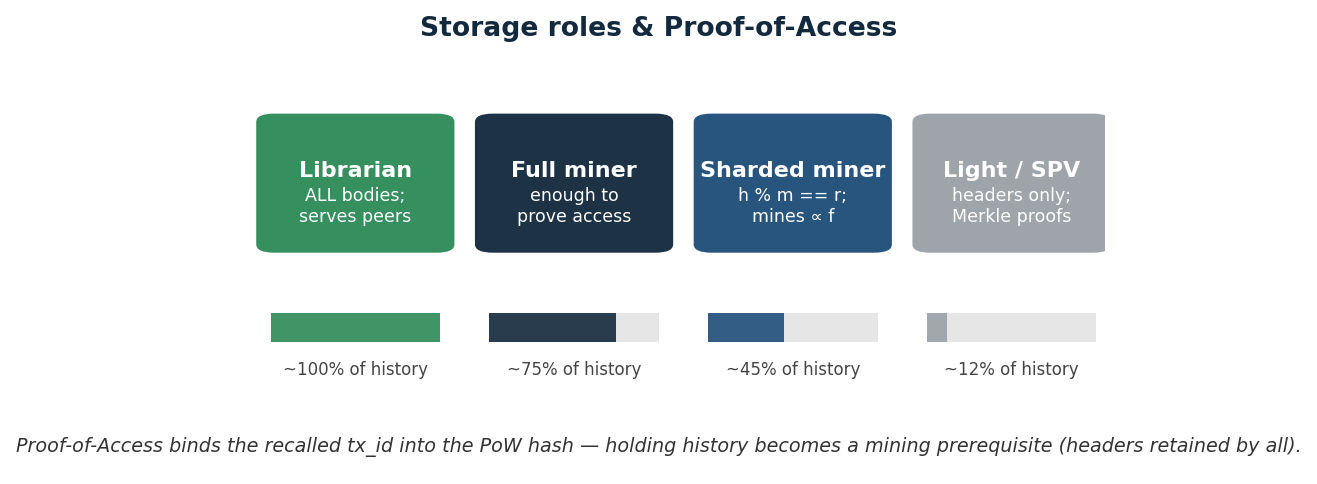
Before adding a new block, a miner can be required to prove it still holds a specific old block the protocol picks at random — a mechanism called block recall. Keeping the full chain history stops being a volunteer chore and becomes a condition of mining, so a network's past can't slowly erode as nodes prune it away.
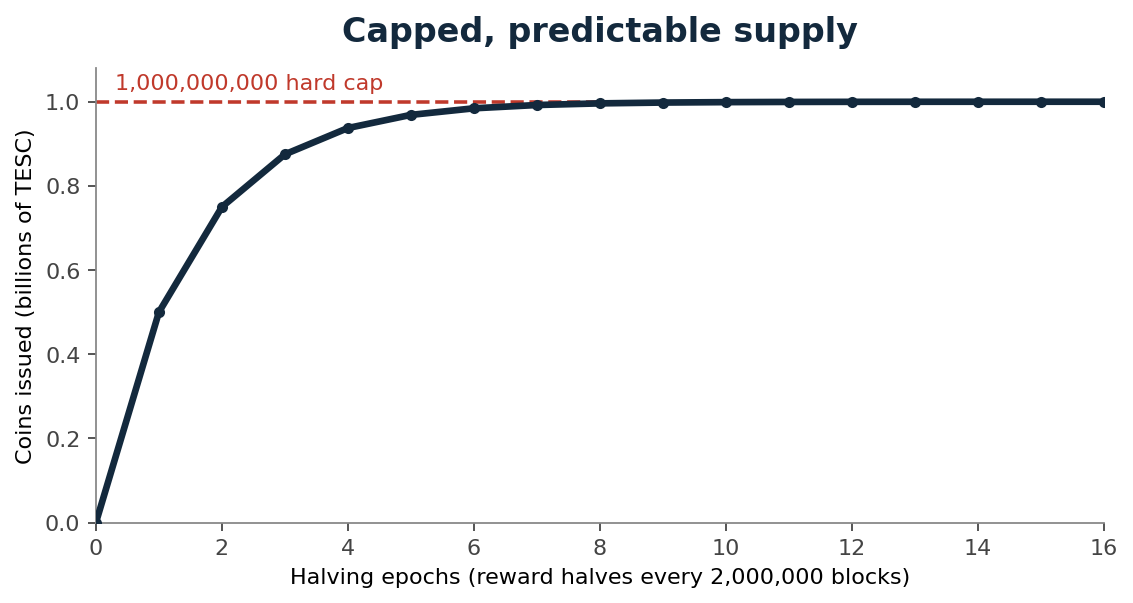
A fixed supply of 1,000,000,000 on a predictable schedule — with 60-second blocks.
Tesseracoin doesn't try to be the next global money. It's a chain for trusted communities — and the design choices follow from that. Here's how it compares to the chains people usually reach for first.
| Concern | Bitcoin | Ethereum | Cosmos chains | Tesseracoin |
|---|---|---|---|---|
| Built for | Permissionless global money | Permissionless programmable apps | App-specific sovereign chains | Networks of any scale — community currency, consortium ledger, or archival storage platform |
| What earns you a reward | Mining hashpower | Staking ETH | Staking the chain's native token | Mining + locked, slashable stake + a stake-weighted random reward shared beyond the miner |
| Energy | Bitcoin-scale PoW | PoS, low energy | PoS, low energy | Energy-light by design — pledge carries part of the security load that raw hash power otherwise would |
| Future-proof crypto | ECDSA (vulnerable to large quantum computers) | ECDSA / BLS | ECDSA / BLS | Post-quantum signatures built in now — not a someday roadmap |
| Upgrading the rules | Soft / hard fork, miner-signalled, contentious | Coordinated client release per hard fork | On-chain governance vote → coordinated binary swap | A single on-chain activation tx co-signed by the founding multisig — networks grow from Pure PoW → POWP-Stake → PoA or Pure PoS without a hard fork or coordinated software upgrade |
| Tunable parameters (block size, fee rate, block time) | Compile-time constants — change = fork | Compile-time constants — change = fork | Module params, governance-tunable | Per-era params as data — tunable via an activation tx, no software upgrade |
| Self-describing chain | Read the client source + BIP list | Read the client source + EIP list | Query module state | Queryable era history with active rules + the changes each activation made (see the Consensus tab) |
| Storage on light devices | SPV is possible but ecosystem-thin | Light clients exist, niche | Varies per chain | Light clients + shared-history storage from day one; block recall makes miners prove they still hold specific historical blocks, so the full history can't quietly disappear |
| DoS / API hardening | Client-level; full nodes rely on OS networking | Client + external reverse proxy | Varies per chain deployment | Three layers: proxy/ingress, per-IP token-bucket rate limiter (consensus-safe — peers exempt), peer misbehaviour scoring |
| Supply cap | 21 million BTC | No hard cap (issuance net of burn) | Varies per chain | 1 billion TESC on a predictable, capped schedule |
Since “owner-signed” can read the wrong way: no one owns the network. No company, no operator. Mining, validation, and gossip are fully peer-to-peer — connected nodes keep producing blocks even if every coordinating service goes dark. The one privileged action is changing the rules, signed in the open at a scheduled height by the community’s own founding multisig (the M-of-N keys set at genesis). It governs upgrades — not nodes, funds, or the chain. Each community holds its own key, and it can be widened or handed on.
The discovery service is just training wheels — it helps nodes find each other on first start. It sits outside consensus, holds no power over the chain, and gives way to peer-to-peer discovery. The network stands without it.
A private currency usable for dues, favours, and real goods within a trusted group — run entirely by the community, with no bank or platform fee.
A shared, tamper-evident record for organisations that need auditable transfers without a central operator. Activate Proof of Authority for deterministic block timing once the network matures.
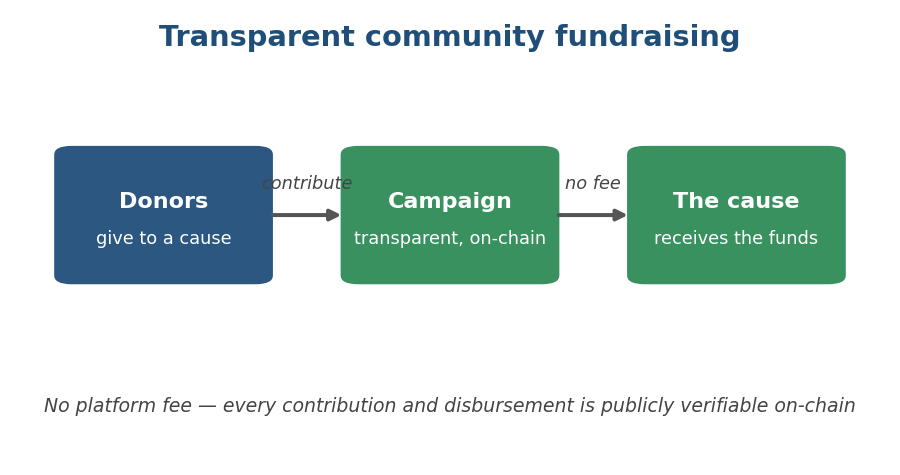
Pool contributions for a shared cause — every contribution and disbursement is publicly verifiable on-chain, with no platform fee.
Enable block recall to require miners to hold and prove historical block bodies — turning the chain into an economically incentivised, tamper-evident archive.
Programmable agreements — escrow, recurring contributions, conditional payouts — that run exactly as written, with no intermediary to trust.
For the curious — a few of the ideas that make Tesseracoin tick.
Difficulty auto-retargets to hold each era's target block time, so block production stays steady whatever the total hash rate. The reward starts at 250 TESC/block and halves by block count — every 2,000,000 blocks — asymptoting to a fixed 1,000,000,000 TESC cap. It's CPU-mineable and energy-light: security leans on pledged, slashable stake as well as work, so there's no ASIC arms race.
* ~0.3 MH/s per Apple M3 Ultra core (the PoW is one SHA-256 over the block header); a typical CPU core lands in the ~0.1–0.3 MH/s range.
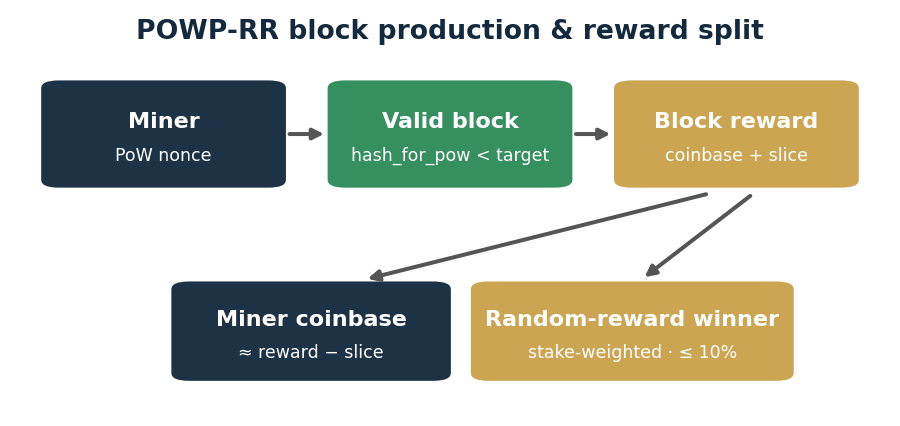
Proof-of-work produces a block; most of the reward goes to the miner, and a slice (≤10%) to a stake-weighted random winner other than the miner.
Every fee has two parts: a base fee plus a tip. The base fee rises with demand and falls back to the floor when blocks empty, and a configurable share of it is burned (currently half). The tip is what you add on top — it goes entirely to the miner, so a higher tip buys faster inclusion when blocks are full. Separately, the block reward halves on a fixed schedule toward a hard 1,000,000,000 cap.


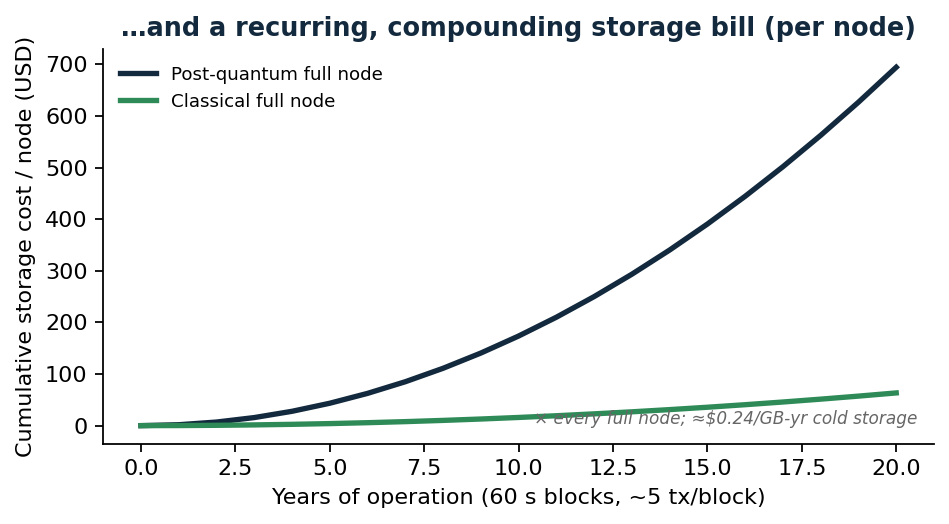
Quantum-safe signatures are large, and naively that makes every node's storage balloon over time. Tesseracoin turns storing history into a shared, rewarded role, so nodes can run light or carry just a slice — keeping participation open to ordinary hardware for the long haul.
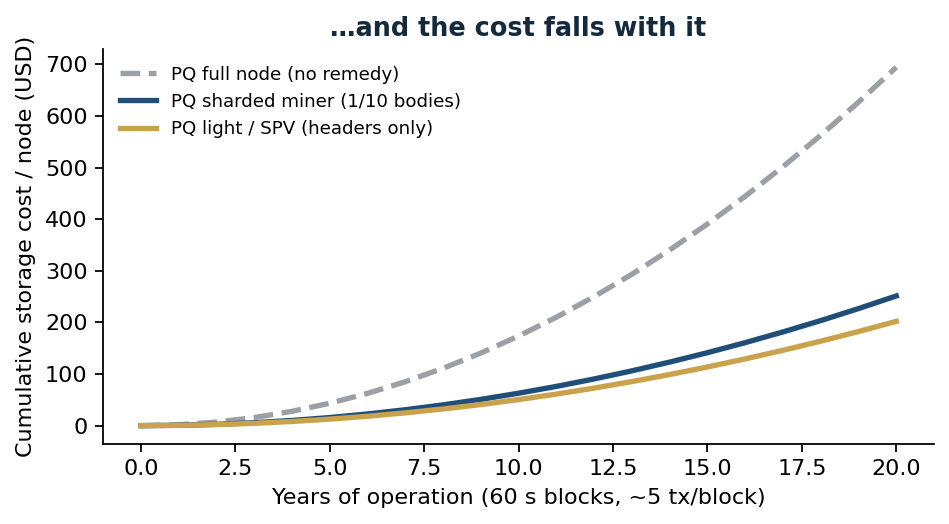
Run a full archive, a partial shard that mines in proportion to what it stores, or a lightweight wallet — all on the same network.
Tesseracoin adapts to the deployment environment rather than requiring a fixed topology.
PEERS=http://node1:8000,http://node2:8000,…; no
discovery service required. Right for air-gapped, fixed-topology,
or consortium networks.Design choices that keep the network adaptable, safe, and self-sustaining at any scale.
Four registered consensus families let a network start simple and grow richer as participation increases — Pure PoW at genesis, POWP-Stake once staking is ready, then Proof of Authority for deterministic governance or Pure Proof-of-Stake for slot-based production at scale. Each transition is a single on-chain activation transaction co-signed by the founding multisig at a scheduled height — no coordinated software upgrade, no community schism, no hard fork.
Three independent layers guard every node: the reverse proxy (nginx or cloud ALB) rate-limits connections before they reach the process; the built-in per-IP token-bucket rate limiter adds a tighter gate for expensive read paths — while peer gossip and chain sync are always exempt so consensus is never throttled; and a peer misbehaviour scorer bans nodes that flood invalid blocks. On-chain, slashable stake punishes equivocators permanently. Every signature is post-quantum (Dilithium2 / FIPS 204 ML-DSA-44) from day one.
Keeping the full history is a first-class role. Librarian nodes retain block bodies and serve them on demand. When block recall is active, the protocol challenges every miner to prove it holds a specific past block — a pruned node cannot mine, so archiving becomes an economic requirement, not just a civic contribution. A direct storage reward for librarians is on the roadmap (see how the network evolves).
Tesseracoin reached its testnet-ready milestone in May 2026 — the core protocol is stable, backed by 1,360+ unit tests and 45 multi-node chaos scenarios (network partitions, node restarts, equivocation, and block-forgery attacks), browser-driven UX automation for the wallet and dashboard, and JMeter stress/load plus adversarial-network DoS testing — and the multi-node sim has soaked clean over extended runs. See it live on the block explorer and try the standalone wallet, which signs transactions in the browser using post-quantum cryptography (Dilithium2 / FIPS 204 ML-DSA-44).
Before launch, a visual network designer lays out a network's consensus eras, economics, and node roles — and spins up a full multi-node simulation of the whole thing, so a community can see how its network behaves before a single real node goes live. A small group can then run its own private Tesseracoin instance from one Docker host in under thirty minutes — see the operator guide.
The explorer is wired to the live development cluster, so it may go briefly dark while the sim is brought down for updates. If you catch it between runs, give it a minute and refresh.
Tesseracoin is being built carefully, in the open spirit it's named for. Follow along as it grows.